In theoretical computer science, the objective of the busy beaver is to find a terminating program of a given size that (depending on definition) either produces the most output possible, denoted by BB(n), or runs for the longest number of steps.
The latest value for n = 5 was recently discovered.
The known values are BB(1) = 1, BB(2) = 6, BB(3) = 21, BB(4) = 107, BB(5) = 47,176,870.
Click here for more information.
Saturday, April 05, 2025

Monday, March 31, 2025
An Amazing Approximation to e
An amazing pandigital approximation to e that is correct to 18,457,734,525,360,901,453,873,570 decimal places is given by:
`e\approx(1+9^(−4^(6⋅7)))^(3^(2^85))`
It was discovered by Richard Sabey in 2004.
Proof:
`(1+9^(−4^(6⋅7)))^(3^(2^85))=(1+9^(−4^42))^(3^(2^85))`
`=(1+9^(−4^42))^(3^(2*2^84))`
`=(1+9^(−4^42))^(3^(2*2^84))`
`=(1+9^(−4^42))^(9^(2^(84)))`
`=(1+9^(−4^42))^(9^(4^42))`
`=(1+\frac{1}{9^(4^42)})^(9^(4^42))`
`=(1+\frac{1}{n})^n`.
`e\approx(1+9^(−4^(6⋅7)))^(3^(2^85))`
It was discovered by Richard Sabey in 2004.
Proof:
`(1+9^(−4^(6⋅7)))^(3^(2^85))=(1+9^(−4^42))^(3^(2^85))`
`=(1+9^(−4^42))^(3^(2*2^84))`
`=(1+9^(−4^42))^(3^(2*2^84))`
`=(1+9^(−4^42))^(9^(2^(84)))`
`=(1+9^(−4^42))^(9^(4^42))`
`=(1+\frac{1}{9^(4^42)})^(9^(4^42))`
`=(1+\frac{1}{n})^n`.
Monday, March 24, 2025
Permutation Rotations
In this paper, we discuss certain properties of permutation rotations on each other.
Click here to read my paper.
Click here to read my paper.
Tuesday, December 17, 2024
52nd Known Mersenne Prime Found!
The Great Internet Mersenne Prime Search (GIMPS) has discovered the largest known prime number, 2136,279,841-1, having 41,024,320 decimal digits. Luke Durant, from San Jose, California, found the prime on October 12th.
Click here for more information.
Click here for more information.
Friday, June 02, 2023
A Chiral Aperiodic Monotile
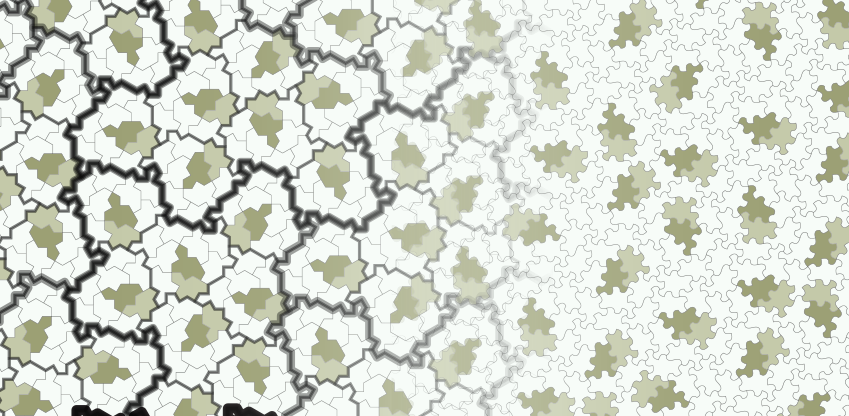
Click here for the article.
Saturday, April 01, 2023
Mathematicians have finally discovered an elusive ‘einstein’ tile

It’s the first true example of an “einstein,” a single shape that forms a special tiling of a plane: Like bathroom floor tile, it can cover an entire surface with no gaps or overlaps but only with a pattern that never repeats.
Click here for more information.
Sunday, July 31, 2022
Value-Counting Up to N
Some interesting properties arise when value-counting the integers sequentially up to N using N digits or fingers and comparing the number of values to the prime-exact equation; with a simple method for testing primes and prime powers (particularly Mersenne and Fermat primes).
Click here to read my paper.
Click here to read my paper.
Wednesday, December 22, 2021
Primality Testing and Factoring Using Pascal's Triangle
An interesting if not impractical way of primality testing and factoring a number using Pascal’s Triangle.
Click here to read my paper.
Click here to read my paper.
Sunday, October 13, 2019
Collatz Conjecture
I've previously linked to Jason Davies website for another article. He has another JavaScript program for the Collatz Conjecture.
To pretty it up, remove the circle fill in collatz.css and modify the circle append (line 83) in collatz.js as follows:
To pretty it up, remove the circle fill in collatz.css and modify the circle append (line 83) in collatz.js as follows:
      nodeEnter.append("circle")
          .attr("fill", function(d) {
            var cc;
            var i = parseInt(d.data);
            if ((i && (i & (i - 1)) === 0) && (i <= 16)) {
              cc = "#0000ff";
            }
            else if ((i % 3) === 0) {
              cc = "#c8c8c8";
            }
            else if ((i % 6) === 1) {
              cc = "#ffff00";
            }
            else if (((i % 2) === 1) || (((i % 3) === 2) && (((i / 2) % 2) === 0))) {
              cc = "#ffa500";
            }
            else {
              cc = "#000000";
            }
            return cc;
          })
         .attr("r", 5);
I was only interested in the initial node for those in orange and yellow.
Thursday, October 10, 2019
Minimal Set for Powers of 2
The minimal set for powers of 2 is currently nondeterministic and can be shown to be more complex than previously proposed.
Click here for my analysis on it.
Click here for my analysis on it.
Monday, July 01, 2019
Mathematicians Discover the Perfect Way to Multiply
Four thousand years ago, the Babylonians invented multiplication. Last month, mathematicians perfected it.
On March 18, two researchers described the fastest method ever discovered for multiplying two very large numbers. The paper marks the culmination of a long-running search to find the most efficient procedure for performing one of the most basic operations in math.
“Everybody thinks basically that the method you learn in school is the best one, but in fact it’s an active area of research,” said Joris van der Hoeven, a mathematician at the French National Center for Scientific Research and one of the co-authors.
Click here and here for more information.
On March 18, two researchers described the fastest method ever discovered for multiplying two very large numbers. The paper marks the culmination of a long-running search to find the most efficient procedure for performing one of the most basic operations in math.
“Everybody thinks basically that the method you learn in school is the best one, but in fact it’s an active area of research,” said Joris van der Hoeven, a mathematician at the French National Center for Scientific Research and one of the co-authors.
Click here and here for more information.
Tuesday, June 18, 2019
A 53-Year-Old Network Coloring Conjecture Is Disproved

A paper posted online last month has disproved a 53-year-old conjecture about the best way to assign colors to the nodes of a network. The paper shows, in a mere three pages, that there are better ways to color certain networks than many mathematicians had supposed possible.
Click here for more information.
Wednesday, April 03, 2019
Andrew Booker, a Mathematics Professor at the University of Bristol, Just Solved a Deceptively Simple Puzzle That Has Boggled Minds for 64 Years
A mathematician in England has cracked a math puzzle that's stumped computers and humans alike for 64 years: How can the number 33 be expressed as the sum of three cubed numbers?
While it might seem simple on its face, this question is part of an enduring number-theory conundrum that goes back to at least 1955 and may have been mulled over by Greek thinkers as early as the third century. The underlying equation to solve looks like this:
`x^3 + y^3 + z^3 = k`
That answer is:
`(8,866,128,975,287,528)^3 + (–8,778,405,442,862,239)^3 + (–2,736,111,468,807,040)^3 = 33`.
Click here for more information.
While it might seem simple on its face, this question is part of an enduring number-theory conundrum that goes back to at least 1955 and may have been mulled over by Greek thinkers as early as the third century. The underlying equation to solve looks like this:
`x^3 + y^3 + z^3 = k`
That answer is:
`(8,866,128,975,287,528)^3 + (–8,778,405,442,862,239)^3 + (–2,736,111,468,807,040)^3 = 33`.
Click here for more information.
Friday, March 22, 2019
Karen Uhlenbeck is first woman to win prestigious maths Abel prize
Mathematician Karen Uhlenbeck has become the first woman to win the Abel prize, sometimes called the Nobel prize of mathematics. She has been awarded the 6 million Norwegian kroner ($700,000) prize for her work in the fields of gauge theory and geometric analysis, which have been credited with far-reaching impact in both mathematics and physics.
Click here for more information.
Click here for more information.
Sunday, January 13, 2019
Mathematician Sir Michael Atiyah dies aged 89

One of the world's foremost mathematicians, Prof Sir Michael Atiyah, has died at the age of 89.
Sir Michael, who worked at Cambridge University before he retired, made outstanding contributions to geometry and topology.
Sir Michael was a recipient of the highest honour in mathematics, a Fields Medal. He died on Friday.
Click here for more information.
Thursday, January 03, 2019
51st Known Mersenne Prime Found!
The Great Internet Mersenne Prime Search (GIMPS) has discovered the largest known prime number, 282,589,933-1, having 24,862,048 digits. A computer volunteered by Patrick Laroche from Ocala, Florida made the find on December 7, 2018. The new prime number, also known as M82589933, is calculated by multiplying together 82,589,933 twos and then subtracting one. It is more than one and a half million digits larger than the previous record prime number.
Click here for more information.
Click here for more information.
Monday, September 24, 2018
Riemann Hypothesis Solved By Sir Michael Atiyah After 160 Years, He Says
One of the world's most renowned mathematicians showed how he solved the 160-year-old Riemann hypothesis at a lecture on Monday — and he will be awarded $1 million if his solution is confirmed.
Sir Michael Atiyah, who has won the two biggest prizes in mathematics — the Fields Medal and Abel Prize — took the stage at the Heidelberg Laureate Forum in Germany on Monday to present his work.
To solve the hypothesis you need to find a way to predict the occurrence of every prime number, even though primes have historically been regarded as randomly distributed.
Aityah's solution will need to be checked by other mathematicians and then published before it is fully accepted and he can claim the prize from the Clay Mathematics Institute of Cambridge.
Click here for more information.
Sir Michael Atiyah, who has won the two biggest prizes in mathematics — the Fields Medal and Abel Prize — took the stage at the Heidelberg Laureate Forum in Germany on Monday to present his work.
To solve the hypothesis you need to find a way to predict the occurrence of every prime number, even though primes have historically been regarded as randomly distributed.
Aityah's solution will need to be checked by other mathematicians and then published before it is fully accepted and he can claim the prize from the Clay Mathematics Institute of Cambridge.
Click here for more information.
Every Positive Integer Is A Sum Of Three Palindromes
For integer g ≥ 5, we prove that any positive integer can be written as a sum of three palindromes in base g.
Click here for more information.
Click here for more information.
Wednesday, August 01, 2018
"Nobel of Mathematics" Stolen Minutes After Awarded
One of the winners of the award known as the Nobel Prize for mathematics had his gold medal stolen minutes after it was given to him. Caucher Birkar, a Kurdish refugee turned Cambridge University math professor, was among four winners of the prestigious Fields Medal on Wednesday in Rio de Janeiro.
It was an embarrassing debut for crime-ridden Rio, the first Latin American city ever to host the Fields ceremony, which takes place every four years. Less than an hour had passed since Birkar, a 40-year-old specialist in algebraic geometry, had been handed his 14-karat gold medal when his briefcase went missing.
Click here for more information.
It was an embarrassing debut for crime-ridden Rio, the first Latin American city ever to host the Fields ceremony, which takes place every four years. Less than an hour had passed since Birkar, a 40-year-old specialist in algebraic geometry, had been handed his 14-karat gold medal when his briefcase went missing.
Click here for more information.
Friday, March 23, 2018
Creator of 'Grand Unified Theory of Mathematics' Wins Prestigious Math Prize
A mathematician who developed what some consider the "grand unified theory of mathematics" has won one of the most prestigious prizes in mathematics.
Robert Langlands, an emeritus professor at the Institute for Advanced Study at Princeton University, has won the Abel Prize, a prestigious mathematics prize that honors a lifetime of groundbreaking work, organizers of the prize announced yesterday (March 20).
Click here for more information.
Robert Langlands, an emeritus professor at the Institute for Advanced Study at Princeton University, has won the Abel Prize, a prestigious mathematics prize that honors a lifetime of groundbreaking work, organizers of the prize announced yesterday (March 20).
Click here for more information.
Wednesday, February 14, 2018
The Science of Magic Angle Sculptures
John V. Muntean was inspired to create the Magic Angle Sculptures through his work with magic angle sample spinning, a scientific technique that mechanically simulates a molecule tumbling through space. The effect is to rapidly interchange the three axes of the Cartesian coordinates (x, y, and z). A complex observable phenomenon in three-dimensional space (such as the nuclear magnetic moments of a static molecule) can be represented by 3 x 3 tensors or sets of nine numbers; spinning at the magic angle simplifies that quantity to single isotropic values.
Click here for his videos.
Click here for his videos.
Friday, January 05, 2018
50th Known Mersenne Prime Found!
Persistence pays off. Jonathan Pace, a GIMPS volunteer for over 14 years, discovered the 50th known Mersenne prime, 277,232,917-1 on December 26, 2017. The prime number is calculated by multiplying together 77,232,917 twos, and then subtracting one. It weighs in at 23,249,425 digits, becoming the largest prime number known to mankind. It bests the previous record prime, also discovered by GIMPS, by 910,807 digits.
Click here for more information.
Click here for more information.
Wednesday, December 06, 2017
Mathematicians Awarded $3 Million for Cracking Century-Old Problem
Christopher Hacon, a mathematician at the University of Utah, and James McKernan, a physicist at the University of California at San Diego, won this year's Breakthrough Prize in Mathematics for proving a long-standing conjecture about how many types of solutions a polynomial equation can have. Polynomial equations are mainstays of high-school algebra — expressions like `x^2+5x+6 = 1` — in which variables are raised to the whole number exponents and added, subtracted and multiplied. The mathematicians showed that even very complicated polynomials have just a finite number of solutions.
Click here for more information.
Click here for more information.
Thursday, August 24, 2017
Mathematical Secrets of Ancient Tablet Unlocked After Nearly a Century of Study
Dating from 1,000 years before Pythagoras’s theorem, the Babylonian clay tablet is a trigonometric table more accurate than any today, say researchers.

At least 1,000 years before the Greek mathematician Pythagoras looked at a right angled triangle and worked out that the square of the longest side is always equal to the sum of the squares of the other two, an unknown Babylonian genius took a clay tablet and a reed pen and marked out not just the same theorem, but a series of trigonometry tables which scientists claim are more accurate than any available today.
The 3,700-year-old broken clay tablet survives in the collections of Columbia University, and scientists now believe they have cracked its secrets.
Click here for more information.
At least 1,000 years before the Greek mathematician Pythagoras looked at a right angled triangle and worked out that the square of the longest side is always equal to the sum of the squares of the other two, an unknown Babylonian genius took a clay tablet and a reed pen and marked out not just the same theorem, but a series of trigonometry tables which scientists claim are more accurate than any available today.
The 3,700-year-old broken clay tablet survives in the collections of Columbia University, and scientists now believe they have cracked its secrets.
Click here for more information.
Thursday, August 17, 2017
The Formula That Plots (Almost) Everything
Hold onto your logic hats! In this article we're going to explore one of the most amazing formulas in maths: Tupper's self-referential formula.
The protagonist of our story is the following inequality:
`1/2<\floor{mod(\floor{\frac{y}{17}}2^(-17\floor{x}-mod(\floor{y},17)),2))`
The plot works by either coloring a square or not coloring it: a square with coordinates (x, y) is colored if the inequality is true for x and y. If not the square is left blank.
If you plot the plot for many values of and , the outcome is the following:

I'll let that sink in a moment. No, your eyes are not deceiving you, the formula plots a bitmap picture of itself! Hence the name Tupper's self-referential formula (though Tupper never called this function that himself in his 2001 paper).
There is one missing detail, however. I haven’t told you the value of the number N on the y-axis.
Click here to read more information and see where Euler's equation appears.
The protagonist of our story is the following inequality:
`1/2<\floor{mod(\floor{\frac{y}{17}}2^(-17\floor{x}-mod(\floor{y},17)),2))`
The plot works by either coloring a square or not coloring it: a square with coordinates (x, y) is colored if the inequality is true for x and y. If not the square is left blank.
If you plot the plot for many values of and , the outcome is the following:
I'll let that sink in a moment. No, your eyes are not deceiving you, the formula plots a bitmap picture of itself! Hence the name Tupper's self-referential formula (though Tupper never called this function that himself in his 2001 paper).
There is one missing detail, however. I haven’t told you the value of the number N on the y-axis.
Click here to read more information and see where Euler's equation appears.
Sunday, July 16, 2017
Math 'Genius' Maryam Mirzakhani Dies At Age 40

Maryam Mirzakhani, an Iranian-born mathematician who was the first woman to win the coveted Fields Medal, died Saturday in a US hospital after a battle with cancer. She was 40.
Click here for more information.
Friday, June 30, 2017
Mathematicians Deliver Formal Proof Of Kepler Conjecture
A team led by mathematician Thomas Hales has delivered a formal proof of the Kepler Conjecture, which is the definitive resolution of a problem that had gone unsolved for more than 300 years. The paper is now available online through Forum of Mathematics, Pi, an open access journal published by Cambridge University Press. This paper not only settles a centuries-old mathematical problem, but is also a major advance in computer verification of complex mathematical proofs.
The Kepler Conjecture was a famous problem in discrete geometry, which asked for the most efficient way to cram spheres into a given space. The answer, while not difficult to guess (it's exactly how oranges are stacked in a supermarket), had been remarkably difficult to prove. Hales and Ferguson originally announced a proof in 1998, but the solution was so long and complicated that a team of a dozen referees spent years working on checking it before giving up..
Click here for more information.
The Kepler Conjecture was a famous problem in discrete geometry, which asked for the most efficient way to cram spheres into a given space. The answer, while not difficult to guess (it's exactly how oranges are stacked in a supermarket), had been remarkably difficult to prove. Hales and Ferguson originally announced a proof in 1998, but the solution was so long and complicated that a team of a dozen referees spent years working on checking it before giving up..
Click here for more information.
Thursday, June 22, 2017

Monday, May 22, 2017
Eccentric French maths genius's 'scribblings' go online
Nearly 18,000 pages of notes by eccentric French maths genius Alexandre Grothendieck were posted online Wednesday by his alma mater, Montpellier University in southern France.
Grothendieck, who died aged 86 in 2014, "revolutionised an entire area of mathematics, algebraic geometry," said Jean-Michel Marin, head of an institute that bears the mathematician's name at the university.
Click here for more information.
Grothendieck, who died aged 86 in 2014, "revolutionised an entire area of mathematics, algebraic geometry," said Jean-Michel Marin, head of an institute that bears the mathematician's name at the university.
Click here for more information.
Math Champion Wins With Answer About Pecking Chicks
A 13-year-old boy from Texas won a national math competition on Monday with an answer rooted in probabilities — and a dash of farming.
The boy, Luke Robitaille, took less than a second to buzz in at the Raytheon Mathcounts National Competition with the correct answer.
The question: In a barn, 100 chicks sit peacefully in a circle. Suddenly, each chick randomly pecks the chick immediately to its left or right. What is the expected number of unpecked chicks?
Click here for more information.
The boy, Luke Robitaille, took less than a second to buzz in at the Raytheon Mathcounts National Competition with the correct answer.
The question: In a barn, 100 chicks sit peacefully in a circle. Suddenly, each chick randomly pecks the chick immediately to its left or right. What is the expected number of unpecked chicks?
Click here for more information.
Sunday, March 26, 2017
New Twist on Sofa Problem that Stumped Mathematicians and Furniture Movers

The Moving Sofa problem asks, what is the largest shape that can move around a right-angled turn? UC Davis mathematician Dan Romik has extended this problem to a hallway with two turns, and shows that a 'bikini top' shaped sofa is the largest so far found that can move down such a hallway.
Click here for more information.
French Mathematician Yves Meyer Wins Top Prize for 'Wavelet Theory'
A French mathematician known for his pioneering work on a theory used for applications ranging from image compression to the detection of gravitational waves from the merging of black holes has earned one of the world's top prizes in mathematics.
Yves Meyer, a professor emeritus in mathematics at the École normale supérieure Paris-Saclay in France, will receive the Abel Prize, the Norwegian Academy of Sciences and Letters (which awards the prize) announced today (March 21) in Oslo. The prize, which comes with a cash award of 6 million Norwegian krone ($710,000), will be bestowed by King Harald V of Norway on May 23.
Meyer was honored largely "for his pivotal role in the development of the mathematical theory of wavelets," the academy said. His work on wavelets began in the mid-1980s.
Click here for more information.
Yves Meyer, a professor emeritus in mathematics at the École normale supérieure Paris-Saclay in France, will receive the Abel Prize, the Norwegian Academy of Sciences and Letters (which awards the prize) announced today (March 21) in Oslo. The prize, which comes with a cash award of 6 million Norwegian krone ($710,000), will be bestowed by King Harald V of Norway on May 23.
Meyer was honored largely "for his pivotal role in the development of the mathematical theory of wavelets," the academy said. His work on wavelets began in the mid-1980s.
Click here for more information.
Thursday, January 19, 2017
Saturday, July 30, 2016
Monday, June 06, 2016
Two-hundred-terabyte maths proof is largest ever
A computer cracks the Boolean Pythagorean triples problem — but is it really maths?
Three computer scientists have announced the largest-ever mathematics proof: a file that comes in at a whopping 200 terabytes, roughly equivalent to all the digitized text held by the US Library of Congress. The researchers have created a 68-gigabyte compressed version of their solution — which would allow anyone with about 30,000 hours of spare processor time to download, reconstruct and verify it — but a human could never hope to read through it.
Click here for more information.
Three computer scientists have announced the largest-ever mathematics proof: a file that comes in at a whopping 200 terabytes, roughly equivalent to all the digitized text held by the US Library of Congress. The researchers have created a 68-gigabyte compressed version of their solution — which would allow anyone with about 30,000 hours of spare processor time to download, reconstruct and verify it — but a human could never hope to read through it.
Click here for more information.
Saturday, March 26, 2016
Fermat's Last Theorem Prize Approved
It was a problem that had baffled mathematicians for centuries -- until British professor Andrew Wiles set his mind to it.
"There are no whole number solutions to the equation xn + yn = zn when n is greater than 2."
Otherwise known as "Fermat's Last Theorem," this equation was first posed by French mathematician Pierre de Fermat in 1637, and had stumped the world's brightest minds for more than 300 years.
In the 1990s, Oxford professor Andrew Wiles finally solved the problem, and this week was awarded the hugely prestigious 2016 Abel Prize -- including a $700,000 windfall.
Click here for more information.
"There are no whole number solutions to the equation xn + yn = zn when n is greater than 2."
Otherwise known as "Fermat's Last Theorem," this equation was first posed by French mathematician Pierre de Fermat in 1637, and had stumped the world's brightest minds for more than 300 years.
In the 1990s, Oxford professor Andrew Wiles finally solved the problem, and this week was awarded the hugely prestigious 2016 Abel Prize -- including a $700,000 windfall.
Click here for more information.
Wednesday, March 16, 2016
Mathematicians Discover Prime Conspiracy
Two mathematicians have uncovered a simple, previously unnoticed property of prime numbers — those numbers that are divisible only by 1 and themselves. Prime numbers, it seems, have decided preferences about the final digits of the primes that immediately follow them.
Among the first billion prime numbers, for instance, a prime ending in 9 is almost 65 percent more likely to be followed by a prime ending in 1 than another prime ending in 9.
Click here for more information.
Among the first billion prime numbers, for instance, a prime ending in 9 is almost 65 percent more likely to be followed by a prime ending in 1 than another prime ending in 9.
Click here for more information.
Tuesday, January 26, 2016
49th Known Mersenne Prime Found!
On January 7th, GIMPS celebrated its 20th anniversary with the discovery of the largest known prime number, 274,207,281-1. Curtis Cooper, one of many thousands of GIMPS volunteers, used one of his university's computers to make the find.
Click here for more information.
Click here for more information.
Monday, August 17, 2015
With Discovery, 3 Scientists Chip Away At An Unsolvable Math Problem

There are now 15 known convex pentagons, or nonregular pentagons with the angles pointing outward, that can "tile the plane."
Click here for more information.
Sunday, August 17, 2014
2014 Fields Medal and Nevanlinna Prize Winners Announced

Click here for more information.
Thursday, May 15, 2014
Thursday, January 30, 2014
The Breasts Equation
This equation is making the rounds this week. However, it doesn't work on IE as of yet.
Google: `e^{-\frac{((x-4)^2+(y-4)^2)^2}{999}}+e^{-\frac{((x+4)^2+(y+4)^2)^2}{999}}+0.1\timese^{-((x+4)^2+(y+4)^2)^2}+0.1\timese^{-((x-4)^2+(y-4)^2)^2}`
Google: `e^{-\frac{((x-4)^2+(y-4)^2)^2}{999}}+e^{-\frac{((x+4)^2+(y+4)^2)^2}{999}}+0.1\timese^{-((x+4)^2+(y+4)^2)^2}+0.1\timese^{-((x-4)^2+(y-4)^2)^2}`
Thursday, May 23, 2013
Belgian Mathematician Wins Abel Prize for Shaping Algebraic Geometry
Pierre Deligne netted the prize, one of the most prestigious in mathematics and worth about $1 million, for proving a deep conjecture about algebraic geometry which has helped to transform number theory and related fields.
Click here for more information.
Monday, May 06, 2013
Kenneth I. Appel, Mathematician Who Harnessed Computer Power, Dies at 80
Kenneth I. Appel, who helped usher the venerable mathematical proof into the computer age, solving a longstanding problem concerning colors on a map with the help of an I.B.M. computer making billions of decisions, died on April 19 in Dover, N.H. He was 80.
Click here for more information.
Click here for more information.
Wednesday, February 06, 2013
48th Known Mersenne Prime Found!
On January 25th, the largest known prime number, 257,885,161-1, was discovered on Great Internet Mersenne Prime Search (GIMPS) volunteer Curtis Cooper's computer. The new prime number, 2 multiplied by itself 57,885,161 times, less one, has 17,425,170 digits.
Click here for more information.
Click here for more information.
Tuesday, November 06, 2012
Sunday, November 04, 2012
Prime Number Patterns (II)
Another interesting article using circles on the distribution of primes and twin primes.
Sunday, September 23, 2012
Proof Claimed For Deep Connection Between Primes
The usually quiet world of mathematics is abuzz with a claim that one of the most important problems in number theory has been solved.
Mathematician Shinichi Mochizuki of Kyoto University in Japan has released a 500-page proof of the abc conjecture, which proposes a relationship between whole numbers — a 'Diophantine' problem.
Click here to continue reading.
Mathematician Shinichi Mochizuki of Kyoto University in Japan has released a 500-page proof of the abc conjecture, which proposes a relationship between whole numbers — a 'Diophantine' problem.
Click here to continue reading.
Wednesday, July 18, 2012
Prime Number Patterns
Prime Number Patterns is a visual representation of determining which natural numbers are prime, deficient, perfect, or abundant.
Monday, February 20, 2012
NASA MathTrax

NASA MathTrax is a graphing tool for middle school and high school students to graph equations, physics simulations or plot data files. The graphs have descriptions and sound so you can hear and read about the graph. Blind and low vision users can access visual math data and graph or experiment with equations and datasets.
'The Scale of the Universe,' by Two Teenage Brothers
Another Flash animation of the size of the universe.
Tuesday, December 06, 2011
Solar System Explained From the Inside Out
An excellent image showing the scale of our solar system.
Thursday, October 20, 2011
Japanese man calculates pi to 10 trillion digits

The latest number-crunching champ isn't a supercomputer--it's a hacked-together PC.
Shigeru Kondo of Iida, Nagano Prefecture, worked with software designed by Northwestern University grad student Alexander Yee, and followed up their 2010 feat of reckoning pi to 5 trillion digits.
The result was achieved earlier this month after 371 days of computation and numerous hard drive failures.
Click here for more information.
Wednesday, September 21, 2011
Babbage Analytical Engine designs to be digitised

The Science Museum in London has agreed to help by digitising the mathematician's original plans.
Eventually the images will be used to create a full working model of the Analytical Engine.
Click here for the full article.
Wednesday, August 03, 2011
Crazy Japanese Math
This is one way to keep kids (i.e., boys) interested in math. Too bad I can't read it.
Economy Statistics
Due to the ongoing bad economy, I decided to add a couple of statistical graphs to show that.
U.S. National Debt Clock : Real Time
US debt problem visualized: Debt stacked in 100 dollar bills
U.S. National Debt Clock : Real Time
US debt problem visualized: Debt stacked in 100 dollar bills

Tuesday, May 24, 2011
FRACTRAN
I came across this mathematical programming article on Wikipedia called FRACTRAN.
FRACTRAN is a Turing-complete esoteric programming language invented by the mathematician John Conway.
What an amazing methodology. I decided to buy the referenced book "Nonplussed!: Mathematical Proof of Implausible Ideas". It's easy to read, but the proof is still difficult to follow. I really need to read it again.
FRACTRAN is a Turing-complete esoteric programming language invented by the mathematician John Conway.
What an amazing methodology. I decided to buy the referenced book "Nonplussed!: Mathematical Proof of Implausible Ideas". It's easy to read, but the proof is still difficult to follow. I really need to read it again.
Tuesday, March 15, 2011

Sunday, February 06, 2011
Extended Midy's Theorem
This is my proof, and an extension, of Midy's Theorem. Someone had referenced this in Wikipedia almost six years ago, but it was recently removed (still in the history) to make Wikipedia more official. Since this blog came about after my proof, I never went back and added it.
Tuesday, January 18, 2011
Microsoft Mathematics 4.01
Microsoft Mathematics provides a graphing calculator that plots in 2D and 3D, step-by-step equation solving, and useful tools to help students with math and science studies.
Be sure to download the Microsoft Mathematics Add-In for Word and OneNote as well.
Be sure to download the Microsoft Mathematics Add-In for Word and OneNote as well.
Tuesday, December 21, 2010
Friday, December 17, 2010
Wednesday, November 17, 2010
NetCalc
NetCalc.org is a prototype web-based graphic calculator aiming to provide advanced mathematical functionality. Functions can be viewed graphically, in table form and as a summary of area and mean values.
Saturday, October 16, 2010
Benoît Mandelbrot, Novel Mathematician, Dies at 85
Benoît B. Mandelbrot, a maverick mathematician who developed an innovative theory of roughness and applied it to physics, biology, finance and many other fields, died on Thursday in Cambridge, Mass. He was 85.
Click here for more information.
Check out Skytopia's website for 3D Mandelbrot fractals.
Click here for more information.
Check out Skytopia's website for 3D Mandelbrot fractals.
Wednesday, August 25, 2010
Simpsons Math
I just came across this awesome website dedicated to all the math trivia found in The Simpsons TV show.
Monday, August 09, 2010
P vs. NP
According to Vinay Deolalikar a research scientist at HP Labs, P is not equal to NP.
His preliminary manuscript can be found here.
His preliminary manuscript can be found here.
Tuesday, July 13, 2010
Sorting Algorithms
My last post on sorting algorithms had static displays. This site shows animations for all the different sorts.

Thursday, July 08, 2010

Thursday, May 27, 2010
Tell Me A Joke
The Wolfram|Alpha search engine returns a different mathematical joke for a "Tell me a joke" query.
Tuesday, May 25, 2010
Martin Gardner: 1914-2010
Martin Gardner, a prolific writer and popularizer of mathematics, and one of the most influential figures in skepticism passed away on Saturday, May 22, 2010.
Click here for more information.
Click here for more information.
Wednesday, May 19, 2010
NIST Releases Successor to Venerable Handbook of Math Functions
The National Institute of Standards and Technology (NIST) has released the Digital Library of Mathematical Functions (DLMF) and its printed companion, the NIST Handbook of Mathematical Functions, the much-anticipated successors to the agency's most widely cited publication of all time. These reference works contain a comprehensive set of tools useful for specialists who work with mathematical modeling and computation.
Click here for more information.
Click here for more information.
No 'Simple Theory of Everything'
The "exceptionally simple theory of everything," proposed by a surfing physicist in 2007, does not hold water, says Emory mathematician Skip Garibaldi.
Garibaldi, a rock climber in his spare time, did the math to disprove the theory, which involves a mysterious structure known as E8. The resulting paper, co-authored by physicist Jacques Distler of the University of Texas, will appear in an upcoming issue of Communications in Mathematical Physics.
Click here for more information.
Click here for original post.
Garibaldi, a rock climber in his spare time, did the math to disprove the theory, which involves a mysterious structure known as E8. The resulting paper, co-authored by physicist Jacques Distler of the University of Texas, will appear in an upcoming issue of Communications in Mathematical Physics.
Click here for more information.
Click here for original post.
Sunday, March 14, 2010

Thursday, February 11, 2010
JSLab PlotTool
A graph plotting tool made entirely in JavaScript. It uses no graphics and the generated source code is W3C compliant.
Currently real valued functions of one variable and parameter functions for plane curves are supported. You can plot using a variety of options like line resolution and axis dimensions. The first beta also adds support for limited zoom functionality. As the graph is computed real time there is no limit for the zoom level.
Currently real valued functions of one variable and parameter functions for plane curves are supported. You can plot using a variety of options like line resolution and axis dimensions. The first beta also adds support for limited zoom functionality. As the graph is computed real time there is no limit for the zoom level.
Thursday, December 17, 2009
Friday, December 11, 2009
Geeky Math Equation Creates Beautiful 3-D World

The quest by a group of math geeks to create a three-dimensional analogue for the mesmerizing Mandelbrot fractal has ended in success.
They call it the Mandelbulb. The 3-D renderings were generated by applying an iterative algorithm to a sphere. The same calculation is applied over and over to the sphere’s points in three dimensions. In spirit, that’s similar to how the original 2-D Mandelbrot set generates its infinite and self-repeating complexity.
Click here for more information.
Saturn’s Hexagon May Be Solar System’s Coolest Mystery

The Cassini spacecraft has returned the best images yet of the strange hexagonal jet stream that flows around the northern pole of Saturn.
First discovered by the Voyager spacecraft in the early 1980s, the hexagon remains a beautiful mystery to astronomers, and one they’ve been waiting for another shot to see for almost three decades.
Click here for more information.
Thursday, November 05, 2009
Not So Fortunate Numbers
A Fortunate number, named after Reo Fortune, for a given positive integer n is the smallest integer m > 1 such that pn# + m is a prime number, where the primorial pn# is the product of the first n prime numbers.
For example, p7# = 2×3×5×7×11×13 = 510,510. The smallest prime number after 510,511 is 510,529. Thus, 510,529 - 510,510 = 29 is a Fortunate number.
Fortune's conjecture states that no Fortunate number is composite. A Fortunate prime is a Fortunate number which is also a prime number. As of 2009, all the known Fortunate numbers are also Fortunate primes.
------------------------------------------------------------
Instead of only using primorial numbers in our sequence, what happens when we use all numbers such that for the largest prime dividing each number in our sequence, the primorial of that prime also divides that number (i.e., 630 = 2×32×5×7 belongs to the sequence since p4# = 210 divides 630)?
512 → 25, 16,384 → 29, and 524,288 → 214 fail to generate Fortunate primes.
Do only perfect powers of two fail to generate Fortunate primes? Is there a pattern?
------------------------------------------------------------
For all numbers less than a billion in our sequence, the following fail to generate a Fortunate prime:
F# Generator
9 512
9 8,388,608
15 4,194,304
15 67,108,864
21 524,288
25 147,456
25 373,248
25 393,216
25 1,062,882
25 1,259,712
25 4,251,528
25 4,718,592
25 5,308,416
25 5,971,968
25 10,077,696
25 17,915,904
25 21,233,664
25 35,831,808
25 42,467,328
25 172,186,884
27 16,384
35 1,119,744
35 1,492,992
35 33,554,432
35 47,775,744
35 150,994,944
35 362,797,056
49 22,118,400
49 31,104,000
49 32,805,000
49 42,187,500
49 56,623,104
49 90,000,000
49 286,654,464
49 364,500,000
49 720,000,000
49 859,963,392
55 679,477,248
65 10,616,832
77 159,252,480
77 188,956,800
85 322,486,272
119 314,572,800
For example, p7# = 2×3×5×7×11×13 = 510,510. The smallest prime number after 510,511 is 510,529. Thus, 510,529 - 510,510 = 29 is a Fortunate number.
Fortune's conjecture states that no Fortunate number is composite. A Fortunate prime is a Fortunate number which is also a prime number. As of 2009, all the known Fortunate numbers are also Fortunate primes.
------------------------------------------------------------
Instead of only using primorial numbers in our sequence, what happens when we use all numbers such that for the largest prime dividing each number in our sequence, the primorial of that prime also divides that number (i.e., 630 = 2×32×5×7 belongs to the sequence since p4# = 210 divides 630)?
512 → 25, 16,384 → 29, and 524,288 → 214 fail to generate Fortunate primes.
Do only perfect powers of two fail to generate Fortunate primes? Is there a pattern?
------------------------------------------------------------
For all numbers less than a billion in our sequence, the following fail to generate a Fortunate prime:
F# Generator
9 512
9 8,388,608
15 4,194,304
15 67,108,864
21 524,288
25 147,456
25 373,248
25 393,216
25 1,062,882
25 1,259,712
25 4,251,528
25 4,718,592
25 5,308,416
25 5,971,968
25 10,077,696
25 17,915,904
25 21,233,664
25 35,831,808
25 42,467,328
25 172,186,884
27 16,384
35 1,119,744
35 1,492,992
35 33,554,432
35 47,775,744
35 150,994,944
35 362,797,056
49 22,118,400
49 31,104,000
49 32,805,000
49 42,187,500
49 56,623,104
49 90,000,000
49 286,654,464
49 364,500,000
49 720,000,000
49 859,963,392
55 679,477,248
65 10,616,832
77 159,252,480
77 188,956,800
85 322,486,272
119 314,572,800
Tuesday, July 28, 2009
J - An Amazing Programming Language
J is a modern, high-level, general-purpose, high-performance programming language. J is portable and runs on Windows, Unix, Mac, and PocketPC handhelds, both as a GUI and in a console.
Plouffe's Inverter
Simon Plouffe has a database of more than 215,000,000 mathematical constants like Pi, E, Catalan or Euler-Mascheroni constant with more than 2 billion digits.
Monday, June 15, 2009
47th Known Mersenne Prime Found!
On April 12th, the 47th known Mersenne prime, 242,643,801-1, a 12,837,064 digit number was found by Odd Magnar Strindmo from Melhus, Norway! This prime is the second largest known prime number, a "mere" 141,125 digits smaller than the Mersenne prime found last August.
Click here for more information.
Click here for more information.
Wednesday, June 03, 2009
Best Visual Illusion of the Year Contest
The Best Visual illusion of the Year Contest is a celebration of the ingenuity and creativity of the world’s premier visual illusion research community. Contestants from all around the world have submitted novel visual illusions (unpublished, or published no earlier than 2008), and an international panel of judges has rated them and narrowed them to the TOP TEN.
Sunday, March 29, 2009
Saturday, February 28, 2009
Quite Basic -- Sieve of Eratosthenes
A BASIC programming website that uses the Sieve of Eratosthenes as an example.
Tuesday, February 24, 2009
Sunday, January 25, 2009
Monday, January 05, 2009
Security Codes
I was entering the four-digit security code to our house, and I realized that it doesn't end with an ENTER (E) key to accept it. The problem with that is you can keep pressing numbers until the right combination is found. Since most keypads use all ten digits (0-9), the total number of combinations should be $10^n$. However, it is the ENTER key that makes it so difficult.
Let D equal the number of digits for the security code. Let K equal the number of digits on the keypad.
For a binary keypad (0, 1) and a three-digit code, our set consists of (000E, 001E, 010E, 011E, 100E, 101E, 110E, 111E). Thus, we have at most $2^3 \times (3+1)$ possible keys to enter, where the plus one is for the ENTER key. Generally speaking, we'd have $K^D \times (D+1)$ possible keys to enter.
Without the ENTER key, we could keep pressing the keypad until all combinations have formed. The minimum number of keys required would be $K^D + D$.
So for a binary keypad, we'd have:
Thus, one only needs to know the string concatenations to be able to guess the right combination if no ENTER or code-stopper key is required.
Update: See De Bruijn Sequence and ProjectEuler #265 for a related problem.
Let D equal the number of digits for the security code. Let K equal the number of digits on the keypad.
For a binary keypad (0, 1) and a three-digit code, our set consists of (000E, 001E, 010E, 011E, 100E, 101E, 110E, 111E). Thus, we have at most $2^3 \times (3+1)$ possible keys to enter, where the plus one is for the ENTER key. Generally speaking, we'd have $K^D \times (D+1)$ possible keys to enter.
Without the ENTER key, we could keep pressing the keypad until all combinations have formed. The minimum number of keys required would be $K^D + D$.
So for a binary keypad, we'd have:
| D | String | Keys (wo/ E) | Keys (w/ E) |
|---|---|---|---|
| 1 | 01 | 2 | 4 |
| 2 | 00110 | 5 | 12 |
| 3 | 0001110100 | 10 | 32 |
| 4 | 0000111100101101000 | 19 | 80 |
| 5 | 000001111100010010101110110011010000 | 36 | 192 |
Thus, one only needs to know the string concatenations to be able to guess the right combination if no ENTER or code-stopper key is required.
Update: See De Bruijn Sequence and ProjectEuler #265 for a related problem.
Tuesday, December 16, 2008
Cinderella
Experience Geometry on your desktop and on the web. Easily create startling geometric constructions! Starting from simple triangle relations, continuing with trigonometric theorems up to fractals and transformation groups Cinderella lets you create and manipulate visualizations in an intuitive, yet powerful way.
Click here for more information.
Click here for more information.
Monday, December 01, 2008
Friday, November 14, 2008
Worldmapper
Worldmapper is a collection of world maps, where territories are re-sized on each map according to the subject of interest.
Monday, November 10, 2008
How online games are solving uncomputable problems
Online games that tap your brainpower without you noticing can crack problems that have defeated the most powerful computers, says Lewis Dartnell. Get involved with distributed computing with these online games and downloads.
Click here for more information.
Click here for more information.
Monday, October 06, 2008
The Eyeballing Game
The Eyeball website gives you some mathematical figures and asks you to eyeball them correctly. I scored a 5.92 on my first try.
Just scored 3.13 on my second try.
More games at the Games for the Brain website.
Just scored 3.13 on my second try.
More games at the Games for the Brain website.
Tuesday, September 16, 2008
Titanic Primes Raced to Win $100,000 Research Award
Researchers have discovered the two largest known prime numbers, a whopping 12,978,189 and 11,185,272 digits long, as part of a 12 year old, world-wide volunteer computing project, the Great Internet Mersenne Prime Search ("GIMPS"). The primes can be written shorthand as 243,112,609-1 and 237,156,667-1. The larger number qualifies for a $100,000 research award, most of which GIMPS will donate to the University of California, Los Angeles (UCLA), and to charity.
Click here for more information.
Click here for more information.
Friday, August 29, 2008
F#
I'm learning F#, Microsoft's latest functional programming language for the .NET family. Very nice and interesting. I recommend buying these books on it: F# for Scientists, Foundations of F#, and Expert F#.
Thursday, July 31, 2008

Subscribe to:
Posts (Atom)

