Monday, June 11, 2007
PlotKit - JavaScript Chart Plotting
PlotKit is a Chart and Graph Plotting Library for JavaScript. It has support for HTML Canvas and also SVG via Adobe SVG Viewer and native browser support. Requires MochiKit - A lightweight JavaScript library.

Friday, June 08, 2007
WIRIS CAS Web Calculator

WIRIS CAS is an on-line platform for mathematical calculations designed for education. It is in fact a CAS that also includes a DGS inside. You can access a powerful calculation toolbar through an HTML page that includes integrals and limits calculation, function graphing in 2D or 3D or symbolic matrices manipulation. It covers all mathematical topics from High School to University level (Calculus, Algebra, …).
Thursday, May 31, 2007
Scientist Solves Rubik's Cube In 26 Moves
It’s a toy that most kids have played with at one time or another, but the findings of Northeastern University Computer Science professor Gene Cooperman and graduate student Dan Kunkle are not child’s play. The two have proven that 26 moves suffice to solve any configuration of a Rubik's cube – a new record. Historically the best that had been proved was 27 moves.
Rubik's Cube, invented in the late 1970s by Erno Rubik of Hungary, is perhaps the most famous combinatorial puzzle of its time. Its packaging boasts billions of combinations, which is actually an understatement. In fact, there are more than 43 quintillion ($4.3252 \times 10^19$) different states that can be reached from any given configuration.
Full article here.
Wednesday, May 30, 2007
TTCalc

TTCalc is a new mathematical calculator. It has a nice user interface, formulas for calculating can be inserted by using a keyboard or a mouse. The result is automatically shown in a second window without using any additional keys such as 'equal'. The program possess trigonometric functions, inverse trigonometric functions, hyperbolic functions, logical operators, logarithms, functions for converting between degrees and radians and so on. Additionally the program allows the user to define his own variables and functions. Calculations are performed by using floating point numbers with three kind of precision, the biggest has 288 bits for its mantissa and 96 bits for its exponent that is about 2.551…e+11925026709067095507636213441 with 85 valid decimal digits. The program independently allows to insert and display values with the base (radix) from two to sixteen.
Scythe Statistical Library
The Scythe Statistical Library is an open source C++ library for statistical computation, written by Daniel Pemstein (University of Illinois), Kevin M. Quinn (Harvard University), and Andrew D. Martin (Washington University). It includes a suite of matrix manipulation functions, a suite of pseudo-random number generators, and a suite of numerical optimization routines. Programs written using Scythe are generally much faster than those written in commonly used interpreted languages, such as R and MATLAB, and can be compiled on any system with the GNU GCC compiler (and perhaps with other C++ compilers). One of the primary design goals of the Scythe developers has been ease of use for non-expert C++ programmers. We provide ease of use through three primary mechanisms: (1) operator and function over-loading, (2) numerous pre-fabricated utility functions, and (3) clear documentation and example programs. Additionally, Scythe is quite flexible and entirely extensible because the source code is available to all users under the GNU General Public License.
Saturday, May 26, 2007

Thursday, May 24, 2007
Graph Sketcher
Graph Sketcher lets you make elegant and precise graphs in seconds, simply by sketching what you want.
Wednesday, May 16, 2007
The Alphabet

What is mathematics without language? What is language without the alphabet? Although, they are somewhat independent of each other since one can count without words and speak without writing, they are not mutually exclusive. The image above was taken from the Phoenician Encyclopedia website, the world's largest web compilation of Phoenician resources & studies.
Tuesday, May 15, 2007
Fractal Land

Fractal Land is were you will find fractal images done with UltraFractal, Fractint, Apophysis & other fractal softwares, and also some links to fractal resources, tutorials and other fractal galleries.
There are two main galleries: The Images and Fractint Images.
I Heart Mathematics

Saw this on the web recently and thought it was cool.
Instead of using $\pm\frac{4}{5}$ for the y-intercept though, the golden ratio φ = $\frac{1\pm\sqrt{5}}{2}$ should have been used for a more natural beauty. Also, what would the equation be in 3D?
Friday, May 11, 2007
MPFRCPP
The Multiple Precision Floating-Point Reliable Library C++ Interface (MPFRCPP) is free object oriented interface to the MPFR library. MPFR provides arbitrary precision arithmetic on floating-point numbers. MPFRCPP overloads operators, functions and represents floating point numbers as class objects to make using of MPFR in OO-programs easier.
Distribution package includes Numeric Analysis / Computer Research C++ Classes with implementation of rational numbers, polynomials (including orthogonal polynomials) and complex numbers.
Distribution package includes Numeric Analysis / Computer Research C++ Classes with implementation of rational numbers, polynomials (including orthogonal polynomials) and complex numbers.
Wednesday, May 09, 2007
The Simpsons


The longest running animation TV show of all time and one of the best cartoons ever. Known for covering humor on every subject. Here' are a couple on Fermat's Last Theorem, Euler's Formula and the Complexity classes P and NP.
Interplanetary Transport Network

The Interplanetary Transport Network (ITN) is a collection of gravitationally determined pathways through the solar system that require very little energy for an object to follow. The ITN makes particular use of Lagrange points as locations where trajectories through space can be redirected using little or no energy. These points have the peculiar property of allowing objects to orbit around them even though there is no material object at them.
Factorization Using the Elliptic Curve Method
Click here for a Java implementation of integer factorization using the elliptic curve method (ECM). Source code included.

Monday, May 07, 2007
Gnuplot
Gnuplot is a portable command-line driven interactive data and function plotting utility for UNIX, IBM OS/2, MS Windows, DOS, Macintosh, VMS, Atari and many other platforms. The software is copyrighted but freely distributed (i.e., you don't have to pay for it). It was originally intended as to allow scientists and students to visualize mathematical functions and data. It does this job pretty well, but has grown to support many non-interactive uses, including web scripting and integration as a plotting engine for third-party applications like Octave. Gnuplot has been supported and under development since 1986.
Saturday, May 05, 2007
Project Euler
Project Euler is a series of challenging mathematical/computer programming problems that will require more than just mathematical insights to solve. Although mathematics will help you arrive at elegant and efficient methods, the use of a computer and programming skills will be required to solve most problems.
The motivation for starting Project Euler, and its continuation, is to provide a platform for the inquiring mind to delve into unfamiliar areas and learn new concepts in a fun and recreational context.
The motivation for starting Project Euler, and its continuation, is to provide a platform for the inquiring mind to delve into unfamiliar areas and learn new concepts in a fun and recreational context.
Friday, May 04, 2007
uCalc
UCALC Windows Graphing Calculator comes with the following features: Expression Evaluator, Unit Converter, User Solution Modules, Graphing, Equation Solver, User Functions & Variables, Summation Tables, Integrator, and General Ledger.
UCalc Fast Math Parser allows programs to evaluate math expressions that are defined at run time. Ease of implementation, flexibility, sturdiness and speed are at the core of the product's design. It includes direct support for Visual Basic, C++ (Microsoft and Borland), PowerBASIC (PB/DLL and PB/CC), and Delphi.
UCalc Fast Math Parser allows programs to evaluate math expressions that are defined at run time. Ease of implementation, flexibility, sturdiness and speed are at the core of the product's design. It includes direct support for Visual Basic, C++ (Microsoft and Borland), PowerBASIC (PB/DLL and PB/CC), and Delphi.
Command Line Quaternions
Quaternions are numbers with 4 parts: one for time, three for space. This project hopes to create command line functions that generate thousands of points of quaternions, to be fed into animation software. Think: analytical animation!
Wolfram Web Resources
In addition to Mathworld, Wolfram Web Resources hosts an extensive list of other sites, including: Demonstrations, Functions, Gallery, Integrals, and Tones,
Thursday, May 03, 2007
Mathematica 6
Mathematica 6 has been released and you can see some nice demonstration over at the Wolfram Demonstration Project.
Calculus Videos
The Department of Mathematics at University of Houston has created this library of calculus videos viewable using Apple's QuickTime. They also have a list of shorter videos for some calculus concepts.
Wednesday, May 02, 2007
Gnofract 4D
Gnofract 4D is a free, open source program which allows anyone to create beautiful images called fractals. The images are automatically created by the computer based on mathematical principles. These include the Mandelbrot and Julia sets and many more. You don't need to do any math: you can explore a universe of images just using a mouse. It runs on Unix-based systems such as Linux and FreeBSD.
Monday, April 30, 2007
SpeQ Mathematics

SpeQ is a small, extensive mathematics program with a simple, intuitive interface. All calculations are entered in a sheet. In there you can freely add, edit and execute all calculations. You can define variables and functions, and plot graphs of your functions. You can save your calculations for later re-use.
Sunday, April 29, 2007
Maths Films

The aim of this website is to provide a source of animated mathematical films, images and text to support the teaching of mathematics in ways that build on the intuitions and powers we have all possessed all our lives.
Saturday, April 28, 2007
What is the 4th Dimension?
Four-dimensional geometry is Euclidean geometry extended into one additional dimension. The prefix "hyper-" is usually used to refer to the four- (and higher-) dimensional analogs of three-dimensional objects, e.g. hypercube, hyperplane, hypersphere. n-dimensional polyhedra are called polytopes.
Here are some interesting notes, images and movies for understanding what the fourth dimension would look like.
Here are some interesting notes, images and movies for understanding what the fourth dimension would look like.

Cornell University Library Historical Mathematics Monographs
The Cornell University Library Historical Mathematics Monographs is a collection of selected monographs with expired copyrights chosen from the mathematics field. These were monographs that were brittle and decaying and in need of rescue. These monographs were digitally scanned and facsimile editions on acid free paper were created.
Friday, April 27, 2007
yEd - Java Graph Editor

yEd is a very powerful graph editor that is written entirely in the Java programming language. It can be used to quickly and effectively generate drawings and to apply automatic layouts to a range of different diagrams and networks.
Thursday, April 26, 2007
What Do Numbers Sound Like?
This website contains a list of math songs. The numbers assigned are actually the major scale degrees that correlate. If you don't know basic music theory, think "Do = 1, Re = 2, Mi = 3, Fa = 4, So = 5, La = 6, Ti = 7, Do + Octave = 8, Re + Octave = 9, and 0 = Quarter Rest." Listen to $\pi$ up to 1,000 digits on the piano alone or on the piano, bass & flute together.
Open (to interpretation) question: Which number sounds the best? Which transcendental constant sounds the best?
Open (to interpretation) question: Which number sounds the best? Which transcendental constant sounds the best?
BBP-Type Formulas
The BBP (named after Bailey-Borwein-Plouffe) is a formula for calculating `\pi` discovered by Simon Plouffe in 1995,
`\pi = \sum_(n=0)^\infty(\frac{4}{8n+1}-\frac{2}{8n+4}-\frac{1}{8n+5}-\frac{1}{8n+6})(1/(16))^n`.
Amazingly, this formula is a digit-extraction algorithm for `\pi` in base 16.
Following the discovery of this and related formulas, similar formulas in other bases were investigated. This class of formulas are now known as BBP-type formulas.
Functional Programming Library for XSLT (FXSL)
Dimitre Novatchev, the author of FXSL, was kind enough to give a more thorough explanation of what FXSL can do. Here's the current list of all the features.
FXSL has quite a bit of support for Math operations:
FXSL has quite a bit of support for Math operations:
- Exponential and logarithmic functions.
- Trigonometic and hiperbolic-trigonometric functions.
- Reverse trigonometric and reverse hyperbolic functions.
- Finding the root of a function of one real argument using Newton-Raphston and the binary-search algorithms.
- Generation of sequences of random numbers with values in a given interval and with certain distributions.
- Numerical differentiation.
- Numerical integration.
- Testing primality of natural numbers.
- Generation of Fibonacci numbers.
An XSL Calculator: The Math Modules of FXSL
Here's a helpful website for doing math problems using XSLT. Section #2 leads to an XSL calculator using the FXSL library.
mimeTex Tutorial
This website offers a LaTex math tutorial for mimeTex. It also has an online editor for you to try out the examples as you learn about LaTex
Mathematics Toolbar
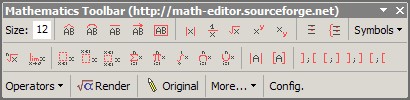
The Mathematics Toolbar consists in a Microsoft Word template document (files with extension « .dot ») displaying a special command bar to the user. With the various buttons offered, the user can then create mathematical formula.
Burr Tools

For people too lazy to solve puzzles themselves, you can use Burr Tools to help solve them for you. This tool is also useful for looking at three-dimensional orthogonal projections.
Infinite Fractal Loop
The Infinite Fractal Loop is a web ring dedicated to fractal art. I found it while browsing Keith's Fractal Art.

Wednesday, April 25, 2007
VisualComplexity
VisualComplexity.com is a unified resource space for anyone interested in the visualization of complex networks. They present a large number of network data similar to ManyEyes. An interesting example of visualization can be seen at ZipDecode.
Tuesday, April 24, 2007
Liquid Journey
An interesting website that has some nice mathematical, chaotic animations using flash.
LaTex Equation Editor
This online LaTex equation editor belongs to the Hamline University Physics Department.
Number Systems of the World
Here's a nice collection in different languages of number systems of the world. Granted, this list is not exhaustive and only includes the first hundred integers and zero.
Monday, April 23, 2007
Natural Numbers
Here's an interesting website called NaturalNumbers.org. They have a couple of free programs that deal with primality testing and zeta functions. One of their more interesting pages has an analysis of the first 100 proximate-prime quadratic polynomials for n = 0 to 1000.
Apfloat for C++
Apfloat is a high performance arbitrary precision package. That means you can do calculations involving millions of digits with it. It uses Number Theoretic Transforms. It's simple to use. It's fast. It's freeware.
Number Spiral

NumberSpiral.com has an interesting report on number spirals which are similar to Ulam's Spiral. The image shown was created using their Vortex application.
Saturday, April 21, 2007

Primality Testing Using RegEx
Here are a couple of interesting methods for doing primality testing using RegEx in Perl and Python.
Method #1 (Perl):
perl -wle 'print "Prime" if (1 x shift) !~ /^1?$|^(11+?)\1+$/'
Method #2 (Perl):
perl -wle 'print "Prime" if (1 x shift) !~ /^1?$|^(11+?)\1+$/' [number]
Method #3 (Python):
import re
def is_prime(num):
return not re.match(r"^1?$|^(11+?)\1+$", "1" * num)
Method #1 (Perl):
perl -wle 'print "Prime" if (1 x shift) !~ /^1?$|^(11+?)\1+$/'
Method #2 (Perl):
perl -wle 'print "Prime" if (1 x shift) !~ /^1?$|^(11+?)\1+$/' [number]
Method #3 (Python):
import re
def is_prime(num):
return not re.match(r"^1?$|^(11+?)\1+$", "1" * num)
Tuesday, April 17, 2007
Prime Numbers in PostScript
Here's an interesting website that shows you how to use a printer to generate prime numbers. It also has a PostScript file that generates ULAM's Spiral.
Monday, April 16, 2007
Ulam's Spiral
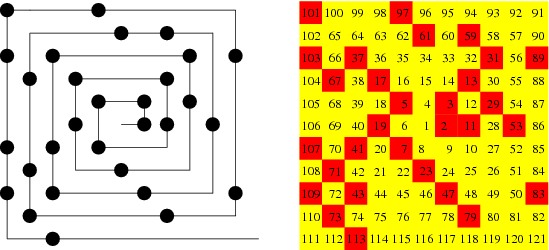
Ulam's Spiral, also known as the Prime Spiral, is a plot in which the positive integers are arranged in a spiral (left figure), with primes indicated in some way along the spiral. In the right plot above, primes are indicated in red and composites are indicated in yellow.
Le Village Premier has an interesting stand-alone Java application that can generate the spiral.
arXiv.org
The Cornell University Library hosts the arXiv.org website. arXiv.org has open access to hundreds of thousands of e-prints in Physics, Mathematics, Computer Science and Quantitative Biology.
Graph Paper
Here are three sites that allow you to create graph paper: WebEE, Incompetech and PDF Pad.
Use some of the grids to test Ulam's Spiral.
Use some of the grids to test Ulam's Spiral.
Sunday, April 15, 2007
Leonhard Euler
Leonhard Euler (pronounced Oiler) was born on April 15, 1707 and died on September 7, 1783. He was a Swiss mathematician who was tutored by Johann Bernoulli. He worked at the Petersburg Academy and Berlin Academy of Science. He had a phenomenal memory, and once did a calculation in his head to settle an argument between students whose computations differed in the fiftieth decimal place. Euler lost sight in his right eye in 1735, and in his left eye in 1766. Nevertheless, aided by his phenomenal memory (and having practiced writing on a large slate when his sight was failing him), he continued to publish his results by dictating them. Euler was the most prolific mathematical writer of all times finding time (even with his 13 children) to publish over 800 papers in his lifetime. He won the Paris Academy Prize 12 times. When asked for an explanation why his memoirs flowed so easily in such huge quantities, Euler is reported to have replied that his pencil seemed to surpass him in intelligence. François Arago said of him "He calculated just as men breathe, as eagles sustain themselves in the air" (Beckmann 1971, p. 143; Boyer 1968, p. 482).
One of the most famous and appealing equations, `e^{i\pi} + 1 = 0` (where `e` is Euler's number, the base of the natural logarithm, `i` is the imaginary unit, one of the two complex numbers whose square is negative one (the other is `-i`), and `\pi` is pi, the ratio of the circumference of a circle to its diameter) was derived by him.
One of the most famous and appealing equations, `e^{i\pi} + 1 = 0` (where `e` is Euler's number, the base of the natural logarithm, `i` is the imaginary unit, one of the two complex numbers whose square is negative one (the other is `-i`), and `\pi` is pi, the ratio of the circumference of a circle to its diameter) was derived by him.
Mathematical Association of America (MAA)
The Mathematical Association of America is the largest professional society that focuses on mathematics accessible at the undergraduate level. Our members include university, college, and high school teachers; graduate and undergraduate students; pure and applied mathematicians; computer scientists; statisticians; and many others in academia, government, business, and industry. We welcome all who are interested in the mathematical sciences.
International Mathematical Olympiad
The International Mathematical Olympiad (IMO) is the World Championship Mathematics Competition for High School students and is held annually in a different country. The first IMO was held in 1959 in Romania, with 7 countries participating. It has gradually expanded to over 90 countries from 5 continents. The IMO Advisory Board ensures that the competition takes place each year and that each host country observes the regulations and traditions of the IMO.
William Lowell Putnam Mathematics Competition
The William Lowell Putnam Mathematics Competition is a North American math contest for college students. Each year on the first Saturday in December, over 2000 students spend 6 hours (in two sittings) trying to solve 12 problems. Individual and team winners (and their schools, in the latter case) get some money and a few minutes of fame.
The Putnam exam problems and solutions can be found here.
The Putnam exam problems and solutions can be found here.
Saturday, April 14, 2007

Create a Graph
The National Center for Education Statistics (NCES), located within the U.S. Department of Education and the Institute of Education Sciences, is the primary federal entity for collecting and analyzing data related to education. A couple of interesting links that they have are a couple of sites to create graphs with flash and without.

Friday, April 13, 2007
Console Calculator

Console Calculator is a fast and powerful command-line calculator. This calculator performs advanced mathematical functions, remembers recent entries, allows creation of user defined variables and custom functions. This calculator is an especially handy tool for software developers or engineering.

MathsNet
MathsNet is an interactive website for learning mathematics. They also have a wide variety of mathematical games and puzzles.
Thursday, April 12, 2007
Wednesday, April 11, 2007
TiddlyMath
TiddlyMath is a web notebook for mathematics. It allows you to create math formulas, diagrams and graphs to display on the web.

Tuesday, April 10, 2007
The Perfect Circle
Rumor has it that they hold competitions for who can draw the most perfect circle by hand. No proof of this yet, but watch this video to be impressed.
Sunday, April 08, 2007
Magic Number Machine

Magic Number Machine is a free, full-featured, graphically laid out, high-precision, scientific calculator for Mac OS X 10.4 and greater. Full source-code is included with the distribution.
Ideal if you need to enter large expressions or have accurate precision. "Data" drawers allow an easy way to generate statistical data, linear regression and Gaussian elimination. The extensive support of complex numbers and hexadecimal numbers is also a significant benefit for anyone who has to work with this type of data.
Requires Mac OS X 10.4 or greater. Native Intel Mac support (universal binary). Source code requires XCode 2.2 or greater.
Friday, April 06, 2007
Thursday, April 05, 2007
Wednesday, April 04, 2007
Mathematics in Movies
This site offers some clips of the mathematical scenes from different movies and TV shows. I hghly recommending watching Sneakers (1992), A Beautiful Mind (2001) and Proof (2005).
Monday, April 02, 2007
Goldbach Conjecture: Proved?
The Goldbach Conjecture states that all positive, even integers ≥ 4 can be expressed as the sum of two primes.
Several papers have recently surfaced at arXiv.org claiming to have proved this. However, none of these methods have been verified yet.
Several papers have recently surfaced at arXiv.org claiming to have proved this. However, none of these methods have been verified yet.
Saturday, March 31, 2007
Fibonacci Sequence
In a book completed in the year 1202, mathematician Leonardo of Pisa (also known as Fibonacci) posed the following problem: How many pairs of rabbits will be produced in a year, beginning with a single pair, if every month each pair bears a new pair that becomes productive from the second month on?
The total number of pairs, month by month, forms the sequence 1, 1, 2, 3, 5, 8, 13, 21, 34, 55, 89, and so on. Each new term is the sum of the previous two terms. This set of numbers is now called the Fibonacci sequence.
Fibonacci numbers come up surprisingly often in nature, from the number of petals in various flowers to the number of scales along a spiral row in a pine cone. They also arise in computer science, especially in sorting or organizing data.
Amazingly, the ratios of successive terms of the Fibonacci sequence get closer and closer to a specific number, often called the golden ratio. It can be calculated as $\frac(1 + \sqrt5)(2)$, or 1.6180339887…. For instance, the ratio 55/34 is 1.617647…, and the next ratio, 89/55, is 1.6181818….

Fibonacci's immortal rabbit problem. A red rectangle designates a newborn pair, which doesn't produce offspring until the second month.
Friday, March 30, 2007
Proof Without Words
13 + 23 + … + n3 = (1 + 2 … + n)2.
Mathematically, $\sum_{i=1}^{n} i^3 = (\sum_{i=1}^{n} i)^2$.
Mathematically, $\sum_{i=1}^{n} i^3 = (\sum_{i=1}^{n} i)^2$.
Thursday, March 29, 2007
Wednesday, March 28, 2007
Tuesday, March 27, 2007
Proof Without Words
1 + 4 + 9 + … + n2 = n(n + 1)(2n + 1)/6.
Mathematically, $\sum_{i=1}^{n} i^2 = \frac{n(n+1)(2n+1)}{6}$.
Mathematically, $\sum_{i=1}^{n} i^2 = \frac{n(n+1)(2n+1)}{6}$.
Monday, March 26, 2007
Scaling and Counting Concepts
Secret Worlds: The Universe Within (Powers of 10) shows you the scale of the universe and the microscopic world.
The MegaPenny Project helps you to visualize large numbers.
The MegaPenny Project helps you to visualize large numbers.
A Dot for Every Second in the Day
Very interesting website that shows you how things are scaled. Similar to Starship Dimensions.
Famous Unsolved Codes and Ciphers
This site contains an unofficial list of well-known unsolved codes and ciphers. A couple of the better-known unsolved ancient historical scripts are also thrown in, since they tend to come up during any discussion of unsolved codes.
Sunday, March 25, 2007
Indian American Mathematician is Awarded the Abel Prize
The Norwegian Academy of Science and Letters has decided to award the Abel Prize for 2007 to Srinivasa S.R. Varadhan, Courant Institute of Mathematical Sciences, New York. He receives the prize “for his fundamental contributions to probability theory and in particular for creating a unified theory of large deviation”.
Click here for more information.
Click here for more information.
Saturday, March 24, 2007
MIT OpenCourseWare
Friday, March 23, 2007
Proof Without Words
Pythagorean Theorem: For a right triangle with legs a and b and hypotenuse c,
$a^2 + b^2 = c^2$.
$a^2 + b^2 = c^2$.
Thursday, March 22, 2007
Wednesday, March 21, 2007
Proof Without Words
1/4 + (1/4)2 + (1/4)3 + … = 1/3.
Mathematically, $\sum_{i=1}^{\infty} \frac{1}{4^i} = \frac{1}{3}$.
Mathematically, $\sum_{i=1}^{\infty} \frac{1}{4^i} = \frac{1}{3}$.
Tuesday, March 20, 2007
Proof Without Words
1 + 2 + 3 + … n = n(n + 1)/2.
Mathematically, $\sum_{i=1}^{n} i = \frac{n(n+1)}{2}$.
Mathematically, $\sum_{i=1}^{n} i = \frac{n(n+1)}{2}$.
Islamic Quasicrystalline Architecture
Medieval Muslims Made Stunning Math Breakthrough
Magnificently sophisticated geometric patterns in medieval Islamic architecture indicate their designers achieved a mathematical breakthrough 500 years earlier than Western scholars, scientists said on Thursday.
By the 15th century, decorative tile patterns on these masterpieces of Islamic architecture reached such complexity that a small number boasted what seem to be "quasicrystalline" designs, Harvard University's Peter Lu and Princeton University's Paul Steinhardt wrote in the journal Science.
Click here for more information.
Monday, March 19, 2007
Lie Groups - E8
Mathematicians Map E8
Mathematicians have mapped the inner workings of one of the most complicated structures ever studied: the object known as the exceptional Lie group E8. This achievement is significant both as an advance in basic knowledge and because of the many connections between E8 and other areas, including string theory and geometry.
Click here for more information.
Proof Without Words
The sum of the first n odd numbers is n2.
Mathematically, $\sum_{i=1}^{n} (2i - 1) = n^2$.
Mathematically, $\sum_{i=1}^{n} (2i - 1) = n^2$.
Friday, March 16, 2007
Starship Dimensions
Okay, this isn't a mathematical post per se, but it does make use of dimensions and exponents.
Note: The images on that site are all exactly to scale, 10 pixels to a meter. Internet Explorer users may Click and Drag the starships to compare them as you like. At the bottom of the image are some contemporary vehicles and buildings for reference. Have fun!
Note: The images on that site are all exactly to scale, 10 pixels to a meter. Internet Explorer users may Click and Drag the starships to compare them as you like. At the bottom of the image are some contemporary vehicles and buildings for reference. Have fun!
GNU MP Bignum Library
The GNU Multiple Precision (MP) Bignum Library is a free library for arbitrary precision arithmetic, operating on signed integers, rational numbers, and floating point numbers. There is no practical limit to the precision except the ones implied by the available memory in the machine GMP runs on. GMP has a rich set of functions, and the functions have a regular interface.
Compare it to MIRACL for functionality and speed.
Compare it to MIRACL for functionality and speed.
Thursday, March 15, 2007
Tuesday, March 13, 2007
Subscribe to:
Posts (Atom)
